
A Pilgrimage of Pain and Poetry: The Purulia Gajan (Charak) Mela – A 2N/3D Guide
The Gajan and Charak festivals of Purulia, West Bengal, are an intense and mesmerizing display of folk faith, ascetic penance, and vibrant tribal arts. Occurring during the searing heat of the Bengali month of Chaitra (mid-March to mid-April), this festival is an essential experience in Indian cultural travel. To truly capture the spirit of Purulia, which is rooted in its agrarian life, the ideal base is the secluded tranquility of Murguma’s Bon Polashi Eco Hut & Camp, a perfect retreat after days of ritual immersion.
The Base: Bon Polashi Eco Hut & Camp
Located strategically near the major temple sites and nestled in the natural landscape of the lateritic plateaus, the Bon Polashi Eco Hut & Camp offers the quintessential Purulia experience. Its proximity provides easy access to festival locations like Deulghata and Budhpur, while the camp setting itself mirrors the simplicity and deep connection to the earth that defines the Gajan festival. The location is an ideal starting point for day trips to the key sites near Purulia town.
Day 1: Arrival, Ascetic Vows, and an Ancient Temple Site
Focus: The Sacred Calendar and Early Rituals
Upon arriving in Purulia (either via rail at Purulia Railway Station or by road), you will head directly to the Bon Polashi Eco Hut & Camp. After check-in, begin your exploration with a visit to one of the ancient temple sites, the Deulghata Complex. This “Land of Temples” is situated on the banks of the Kangsabati (Kasai) river and features impressive Rekha Deul style brick structures. The Gajan here is historically significant, performed amidst ruins that transitioned from Jain to Hindu shrines.
The first day coincides with the “ascetic life” (Sannyasa) being taken up by the Gajan Sannyasis, who are predominantly common villagers from agrarian backgrounds. If your trip is planned for the climax, this day, April 13, 2026 (Chaitra 30), will feature the Neel Puja / Neel Sasthi, which involves the ritual marriage of Shiva and Nilavati.
- Accommodation: Bon Polashi Eco Hut & Camp.
- Festival Highlight: Observing the Habishyi (donning the sacred thread) and the Neel Puja.
- Cuisine Focus: A simple, hearty Purulia meal, which may feature duck meat (Hansher Mangsho) and rice-flour rotis.
Day 2: The Climax of Ordeals and the Spirit of Shiva
Focus: Baanphonra, Charak Puja, and Folk Performances
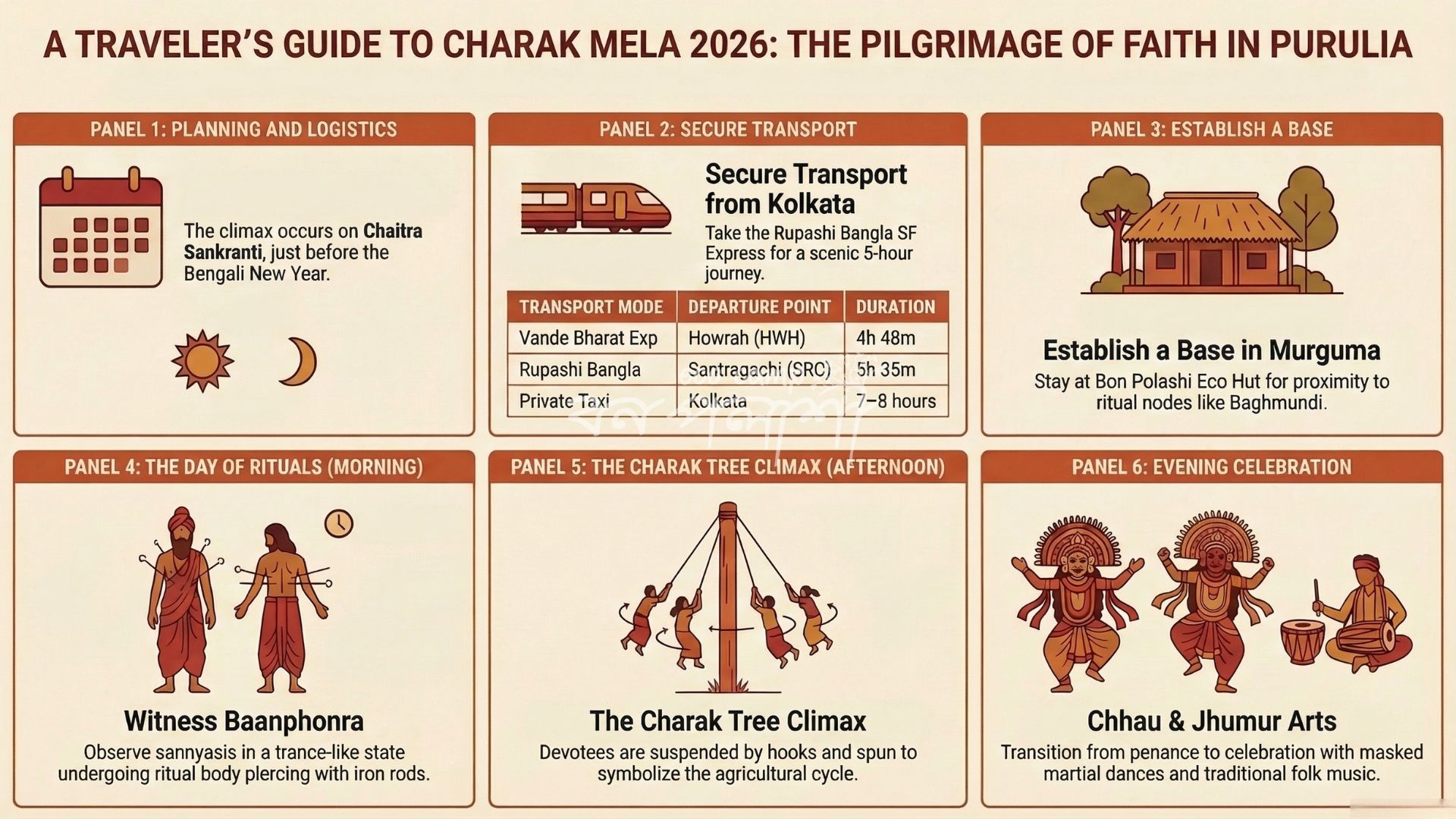
Day two is the most intense, culminating on April 14, 2026 (Chaitra Sankranti), the final day of the Bengali solar year.
- Morning Ritual (Baanphonra): Start your day early (around 4:00 AM) at a temple courtyard to witness Baanphonra, the ceremonial body piercing with long iron rods through the tongue, lips, or arms. This act is viewed as a “sacrificial offering” of the self and is often performed by sannyasis in a trance-like state. A unique local practice is placing Kala Puspa leaves in the mouth after the rods are removed, which are believed to have healing properties.
- Afternoon Climax (Charak Puja): This is the main event. It centers on the Charak Tree, a tall wooden pole that has been ritually immersed in water for weeks to symbolize “aquatic fertility”. The ritual involves hook-swinging, where a devotee is suspended by hooks pierced through the skin of their back and spun in circles. This rotation symbolically represents the “unfolding of the agricultural cycle”.
- Evening Culture (Chhau and Jhumur): In the evening, the spiritual intensity gives way to cultural splendor. The Gajan of Purulia is distinguished by the performance of the Chhau dance. Chhau troupes use elaborate masks (meticulously crafted in Charida village) to portray epic themes. Complementing the dance is Jhumur music, a folk tradition praising Lord Shiva and Parvati, often set to the rhythmic beat of the Madal and Flute.
- Accommodation: Bon Polashi Eco Hut & Camp.
- Festival Highlight: Witnessing the physical ordeals of Baanphonra and the Charak Hook-Swinging ritual.
- Ethical Note: Maintain respect for this living place of worship, dress modestly, and avoid showing visible shock, as the acts are of deep faith.
Day 3: New Year Feast, Local Craft, and Farewell
Focus: Pohela Boishakh and Artisan Heritage
Day three, April 15, 2026 (Boishakh 1, 1433 Bengali Era), marks the Pohela Boishakh or Bengali New Year, signifying a fresh start for trade and agriculture.
- Morning at the Mela: Visit the associated Mela (Fair), which is a key socio-economic event. The fair is a marketplace for local artisans and a hub for traditional food. Look for the iconic Chhau Masks (often sold as décor) and Pottery with intricate designs. You may also find traditional weaving and textiles and metalwork ritual implements.
- A Culinary Farewell: The culinary highlight is the Pitha, a seasonal item. Try the sweet Gur Pitha (deep-fried rice flour with jaggery) or the savory Desi Cock Pitha (with a high “punch” flavor from mustard oil and country chicken). This festive meal is the perfect way to conclude your trip.
- Departure: Head back to Purulia town for your rail or road journey home, carrying with you the indelible memory of the resilient folk-culture.
- Festival Highlight: Experiencing Pohela Boishakh and exploring the Gajan Mela for local crafts and Pithas.
- Departure: Departure from Bon Polashi Eco Hut & Camp.
Archaeological Sites and Religious Transitions
| Site | Location | Material/Style | Historical Evolution | Primary Deity during Gajan |
| Deulghata | Arsha Block (Boram) | Brick; Rekha Deul | Jain origin (10th-12th C) transitioned to Shaivite | Shiva (Linga) and “Kalo” Durga |
| Pakbira | Purulia-Puncha Road | Stone; Rekha Deul | Largest Jain site in Purulia; colossal Padmaprabha statue | Padmaprabha worshipped as “Bhairavnath” (Shiva) |
| Budhpur | Manbazar Block | Stone ruins | Buddhist/Jain origin transitioned to Shiva | Shiva (Bhairavnath) |
| Banda | Raghunathpur II | Sandstone; Triratha | Star-shaped plan; 11th C Rekha Deul | Shiva |
Professional Guide
For researchers and visual storytellers, the Gajan of Purulia offers a visually magnetic subject characterized by “ritual intensity and raw physicality” However, the intense and sometimes “macabre” nature of the rituals- such as the use of human skulls in certain villages- requires a high degree of ethical awareness
Ethical Considerations and Etiquette
- Maintain Respect for the Sacred: Gajan is a “living place of worship”.41 Avoid walking across the path of performers or sannyasis during sensitive rituals like Baanphonra or the Charak swing.
- Ask for Permission: While people are generally camera-friendly, seeking verbal or non-verbal permission for intimate portraits of “monks or elderly people” is a sign of respect.
- Dress Modestly: When entering temple courtyards or “Mondir Tola,” ensure arms and legs are covered
- Sensitivity to Pain: Recognize that what appears as “gore” or “mutilation” to an outsider is an act of deep faith for the participant. Avoid ridiculing or showing visible shock, as this can be offensive to the devotees.
- Restrictions on Secretive Acts: Certain practices, such as the “collection of skulls” from burial grounds, are often secretive and should not be photographed without explicit consent, as it may lead to community tensions.
Practical Photography Tips
- Gear Selection: Festivals move quickly; a “70-300 mm lens” is ideal for capturing both close-up ritual details and distant crowd scenes without intruding.
- Lighting: The “Golden Hour” (early morning and late afternoon) is best for highlighting the vibrant colors of masks and red sannyasi robes.
- Capture the Motion: Use slow shutter speeds to capture the “dynamic motions” of Chhau dancers or the spinning Charak.
- Focus on the Eyes: Direct eye contact in portraits can yield “vivid and expressive” shots that capture the trance-like state of the devotee.